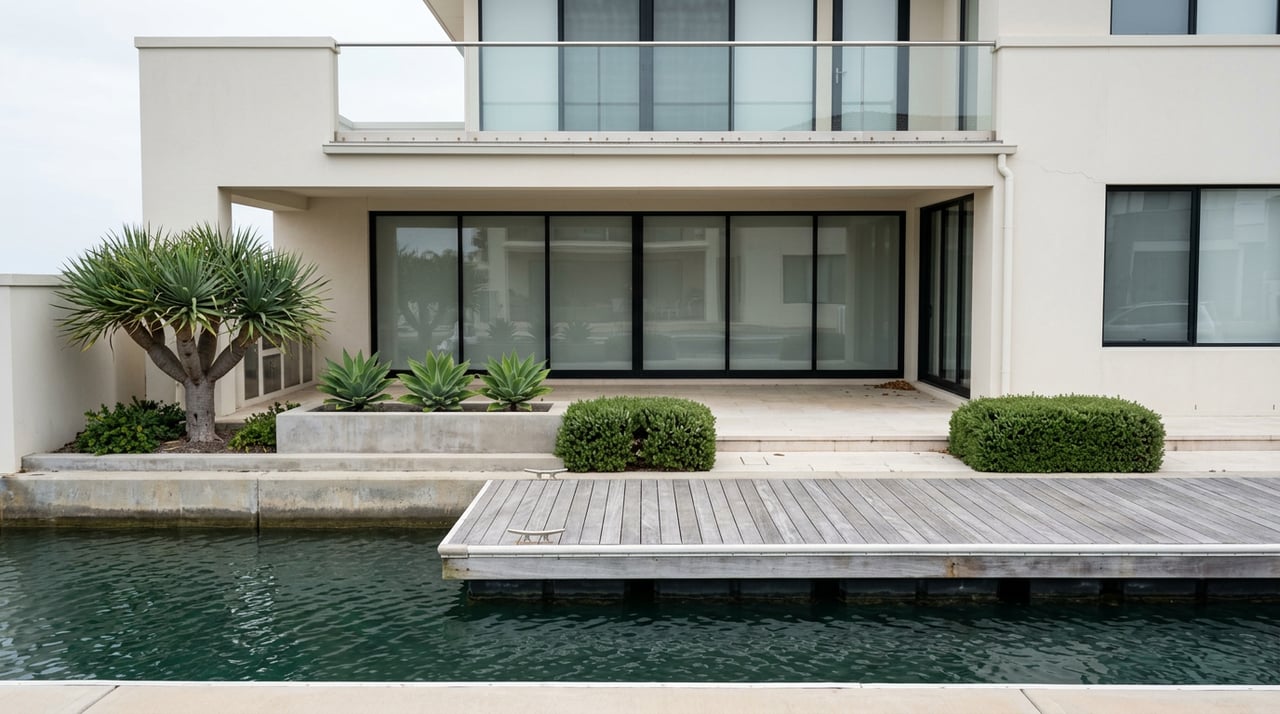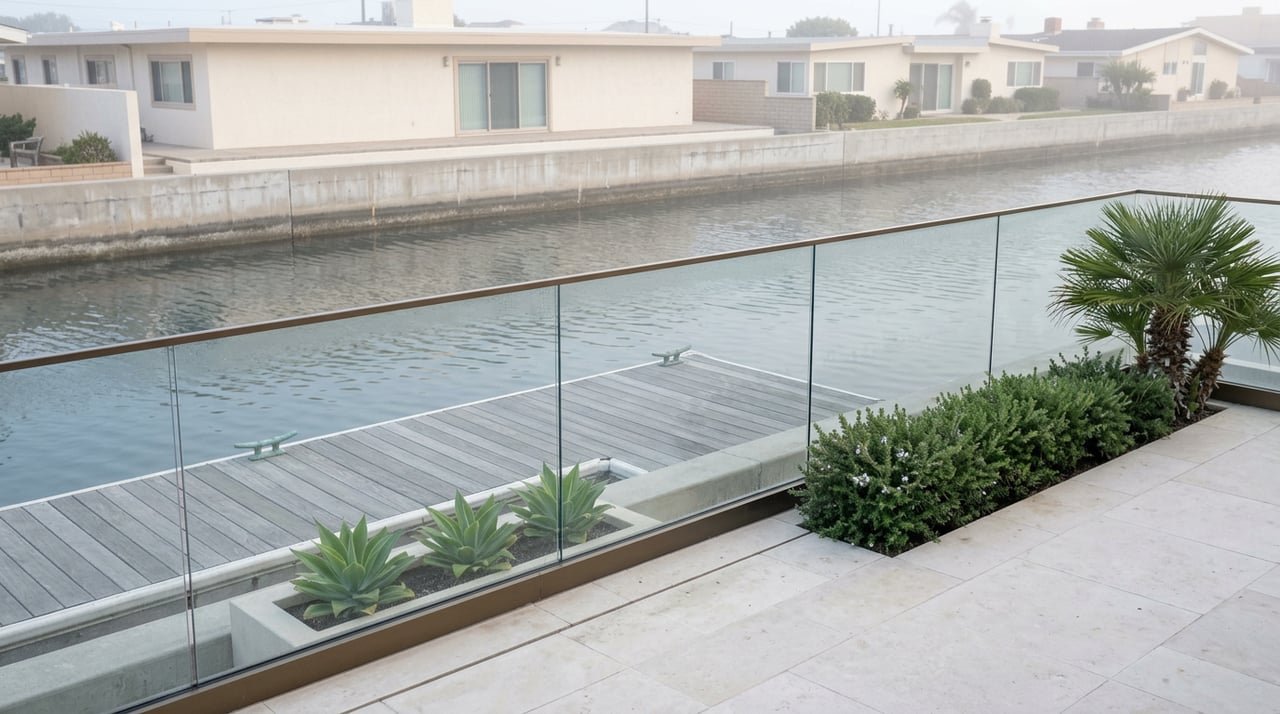
If you live along West Hemlock Street in Mandalay Bay, you know the sound hydroblasting makes against a concrete pilaster. It started the week of April 13 this year, and if your dock backs up to the 3900 to 3966 block, you probably heard it before you saw the crew. That noise was the sound of the first real construction on this community's seawalls since the 1990s, and as of this month it's essentially done.
Here's what a lot of residents don't realize: the section that just got fixed covers 370 linear feet. The city's own project page puts Mandalay Bay's total seawall length at roughly 7 miles. Do the math and that pilot project addressed about one percent of the total wall.
What Actually Got Built on West Hemlock
The city awarded the contract to Jilk Heavy Construction in November 2025, and work began in earnest in January 2026 after homeowners in the affected block relocated their boats to open docks nearby. The scope, according to the Water Quality Certification issued for the project, called for repairing 33 pilasters and 32 panels along that stretch of wall. The method: strip about two inches of deteriorated concrete off each pilaster, coat any exposed rebar with corrosion-resistant epoxy, then wrap it in a new 6.5-inch concrete jacket. New weep holes went in to relieve water pressure behind the wall, along with panel repairs using Sika and Quakewrap systems.
Tamara Ojeda, the city's project manager overseeing the work, has been the point of contact for residents with questions since construction started. A tentative completion date of August 28 was set in July, which puts this project wrapping right around now, roughly eight months after the crews first moved in and about thirteen years after the city and the homeowners association first agreed in writing on how to split the bill.
Two Different Walls, One Long Problem
Not all of Mandalay Bay's seawall is built the same way, and that distinction matters if you're trying to understand why some blocks get fixed before others.
The eastern side of the community, built first starting around 1968, uses what's called a Boise wall: a pilaster-and-panel system with precast concrete panels tied back into the soil behind them. When a developer took over construction and finished the western side by 1973, the design shifted to a Zurn wall, a cast-in-place concrete cantilever system sitting on timber piles, with vertical piles spaced six feet apart and battered piles every twelve feet. The wall stems run nine feet tall and taper from seven inches thick at the top to twelve at the base.
Both systems were built to the codes of their era, which means both predate modern seismic standards and current understanding of how marine environments eat away at reinforced concrete. West Hemlock happens to sit on the Boise side, which is why it became the test case: engineers wanted a manageable, well-documented section to prove out repair methods before committing to the rest.
Where the Money Actually Came From
The full project carried a budget of $2,586,765. Jilk's construction contract came in at $2,210,910, which includes a $221,091 contingency, roughly ten percent of the contract value built in for the unexpected. Another $154,764, about seven percent, covers engineering, inspection, survey work, and project management.
| Budget Line | Amount |
|---|---|
| Construction contract (Jilk Heavy Construction) | $2,210,910 |
| Contingency (10% of contract) | $221,091 |
| Engineering, inspection, survey, project management | $154,764 |
| Total project funds | $2,586,765 |
That money doesn't come from a single source. Mandalay Bay's seawall repairs are funded through a 50/50 split between the City of Oxnard and the Waterway Maintenance Assessment District, known as WAD1, which is the line item that shows up on property tax bills for homes in this district. Separately, the Channel Islands Waterfront Homeowners Association collects $50 in annual dues and a $75 transfer fee when a home changes hands, though those dues fund the HOA's own operations and advocacy work rather than the seawalls themselves.
The Decade It Took to Get Here
The paper trail on this project goes back further than most residents probably realize.
- 2005: the city told the homeowners association that existing assessment funds were, in the city's own words at the time, grossly inadequate for the scale of repairs needed. The estimate that year to fully replace the community's seawall, then measured at 7.8 miles, came to $56 million, or $1,359.72 per linear foot.
- 2012: the city agreed to split future major repair costs 50/50 with the assessment district, a shift from the earlier arrangement where property owners alone funded routine maintenance.
- April 9, 2013: that agreement was formalized in writing between the city and the homeowners association.
- May 10, 2024: the California Coastal Commission approved the permitting for the West Hemlock project.
- June 4, 2024: the city council allocated $2.5 million toward the project in that year's Capital Improvement budget.
- June 26 to August 6, 2025: the city published its formal bid notice and opened construction bids.
- September 16, 2025: the council approved the construction contract with Jilk Heavy Construction.
- January through August 2026: construction, from boat relocation through hydroblasting to the tentative wrap-up date in late August.
That's just over two decades from the first honest assessment of the problem to the first block getting physically repaired. If you've lived in Mandalay Bay long enough to remember HOA meetings about this from before the pandemic, you're not imagining how long this took.
What Happens to the Other 99 Percent
The West Hemlock repair was never meant to fix the whole community. It was designed as a pilot, a way to test the pilaster-jacket method on a manageable stretch before scaling it up. Separately, a five-year monitoring plan led by Duncan Engineering has already identified an estimated 3,095 linear feet of footings and foundations across roughly 95 to 105 locations that need attention in the years ahead. That's more than eight times the length of what just got repaired, and it doesn't include the sections that haven't been surveyed yet.
The engineering documentation generated from West Hemlock, cost estimates, repair timelines, contractor performance, is what the city and the homeowners association plan to use to build a case for larger-scale bonding on the remaining seawall. Nothing about that process moves fast. If this pilot is any indication, expect years between "identified as a priority" and "crew shows up with a hydroblaster."
For homeowners along the water, the practical takeaways are straightforward. Watch for notices from the city's Special Districts division if your address falls within a future priority zone. If your dock is affected, expect the same pattern West Hemlock residents saw: a longer advance notice, followed by a 30-day notice with specific contractor contact information, followed by requests to temporarily relocate boats and dock equipment. And if you're budgeting for a home here, know that the Waterways Assessment District fee on your tax bill isn't cosmetic. It's the mechanism paying for exactly this kind of work, one several-hundred-foot stretch at a time.
Living behind a private dock in Mandalay Bay means living behind infrastructure that's now pushing sixty years old. The good news is the city and the HOA have finally proven a repair method works. The harder news is that proving it took over a decade, and there's still roughly 6.9 miles left to go.
If you're weighing a purchase along Mandalay Bay's canals, or wondering what a seawall's condition and assessment history actually mean for a specific property, Homes by Billy can walk you through what to check before you write an offer. Call Me 🤙🏻